Verb Conjugation in Russian
In Russian, verbs change their endings to indicate who is performing an action and whether it involves one person or several. This process is called conjugation.
There are two primary types of verb conjugation in Russian — the first (I) and the second (II).
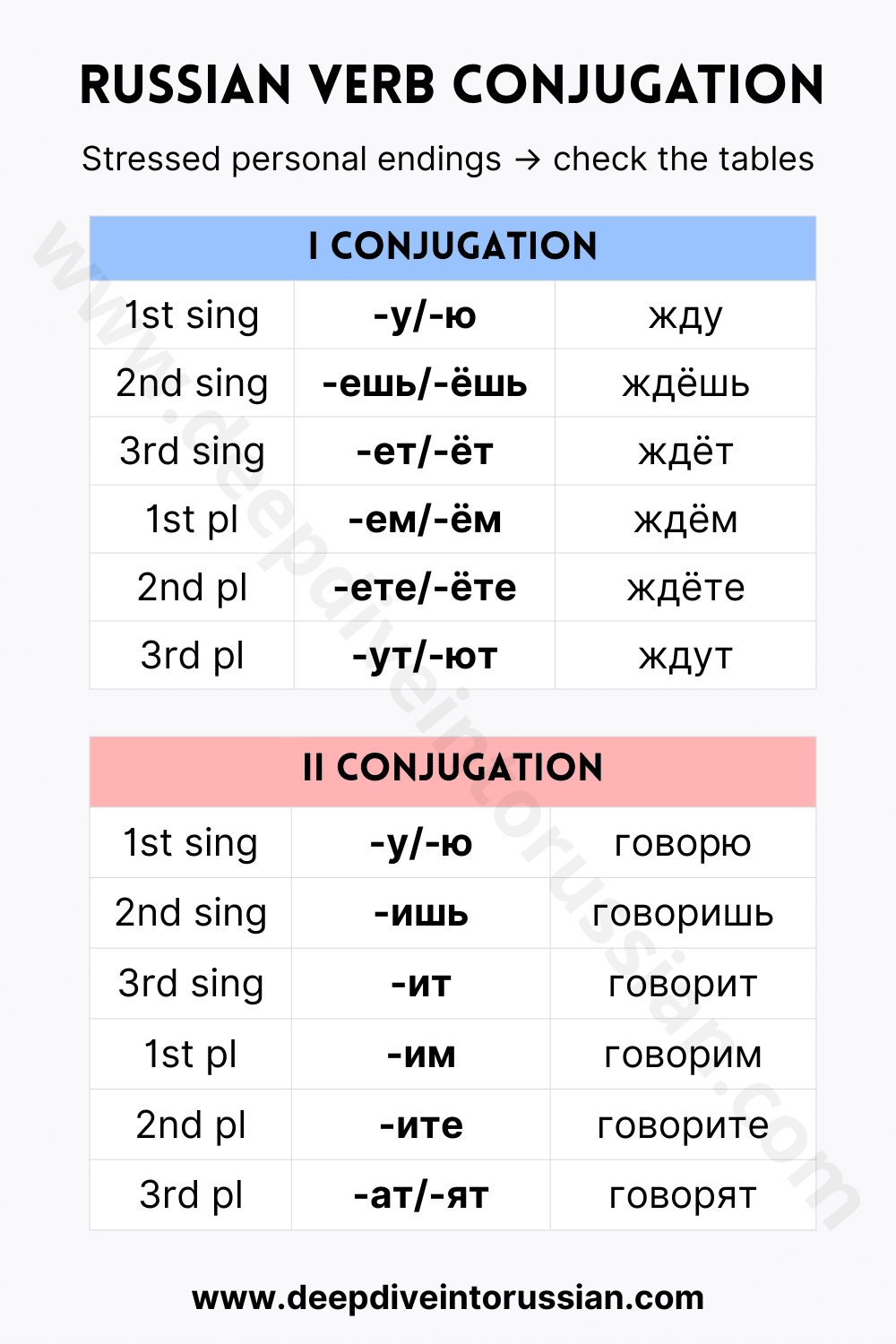
The table below shows verb endings in the present and future tenses.
| Person | I conjugation | II conjugation |
| 1st sing | -у/-ю | -у/-ю |
| 2nd sing | -ешь/-ёшь | -ишь |
| 3rd sing | -ет/-ёт | -ит |
| 1st pl | -ем/-ём | -им |
| 2nd pl | -ете/-ёте | -ите |
| 3rd pl | -ут/-ют | -ат/-ят |
As a rule, for verbs that are not exceptions and do not have any stem alternations, you simply remove -ть, -ти or -чь from the infinitive and then add the appropriate ending depending on the conjugation.
How to Determine a Verb Conjugation
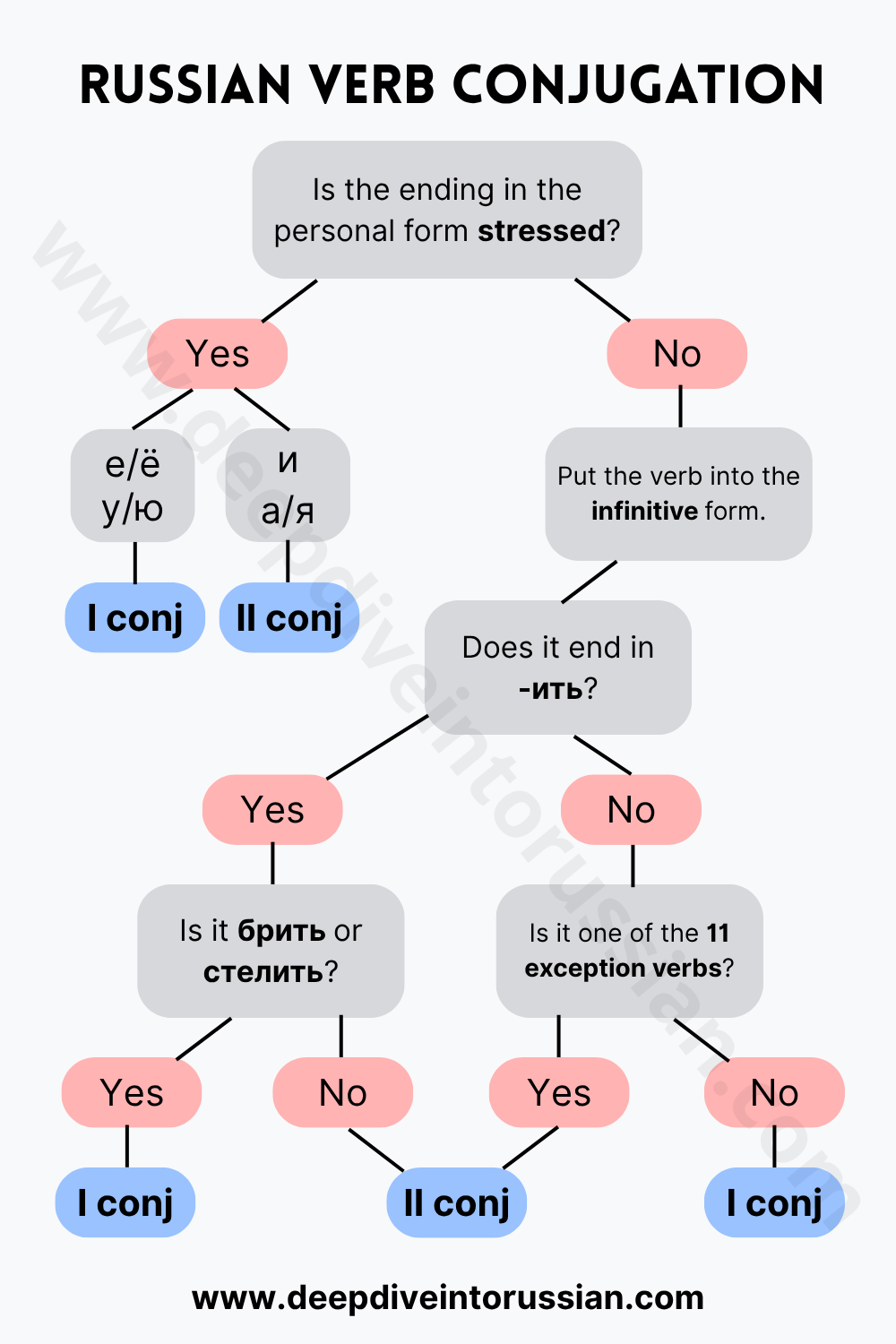
A verb conjugation is determined either by its endings in the personal form or by the infinitive form.
Method 1: By Endings (if endings are stressed)
When a personal ending is stressed, its vowel is clearly heard, which usually indicates the verb’s conjugation. (See the table above.)
I conjugation — endings typically contain the vowels ‘е/ё’ and ‘у/ю’
II conjugation — endings typically contain the vowels ‘и’ and ‘а/я’
Examples:
ты ждёшь (you wait) → vowel ‘ё’ → I conjugation
мы говори́м (we speak) → vowel ‘и’ → II conjugation
💡 Tip: To help students remember, it is often said that the letter Е has one vertical stroke — this represents the I conjugation, while the letter И has two vertical strokes — this represents the II conjugation.
Method 2: By Infinitive (if endings are unstressed)
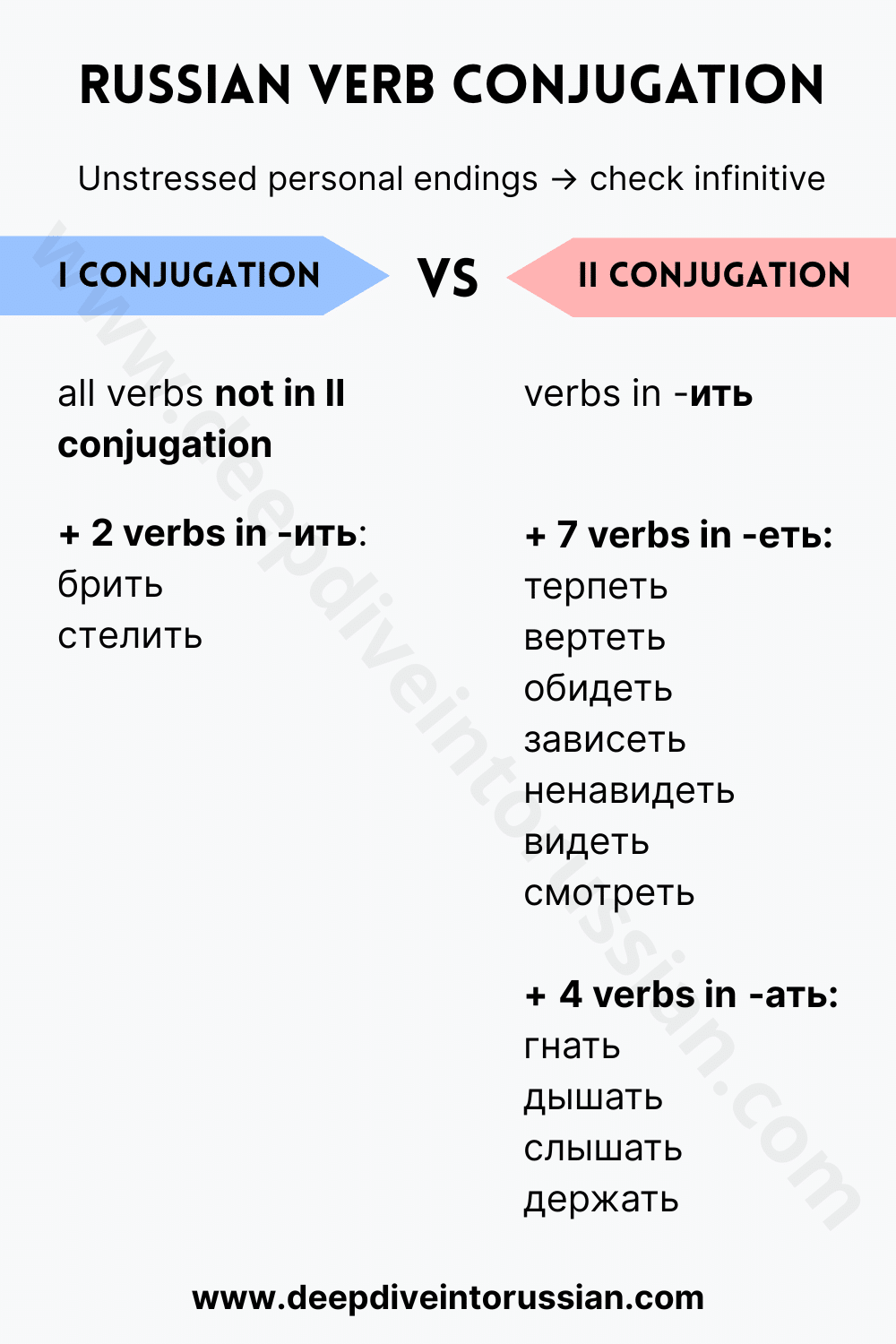
If the endings are unstressed, the conjugation can be determined by the infinitive form.
I conjugation verbs usually end in:
- -ать: писа́ть (to write)
- -ять: теря́ть (to lose)
- -оть: коло́ть (to prick)
- -еть: греть (to heat)
- -уть: тяну́ть (to pull)
- -ыть: мыть (to wash)
II conjugation verbs usually end in:
- -ить: люби́ть (to love), учи́ть (to learn/teach), носи́ть (to carry/wear)
Exceptions to Memorise
Most verbs follow the rules above, but a small group must simply be memorised.
I conjugation:
- Two verbs ending in -ить:
- брить (to shave)
- стели́ть (to spread/lay)
II conjugation:
- Seven verbs ending in -еть:
- терпе́ть (to tolerate)
- верте́ть (to spin/twist)
- оби́деть (to offend)
- зави́сеть (to depend)
- ненави́деть (to hate)
- ви́деть (to see)
- смотре́ть (to watch)
- Four verbs ending in -ать:
- гнать (to chase)
- дыша́ть (to breathe)
- слы́шать (to hear)
- держа́ть (to hold)
Mixed Conjugation Verbs
A few verbs combine endings from both conjugations. The main examples are хоте́ть (to want), бежа́ть (to run), чтить (to honour).
| Person | Хотеть | Бежать | Чтить |
|---|---|---|---|
| 1st sing | хочу́ | бегу́ | чту |
| 2nd sing | хо́чешь | бежи́шь | чтишь |
| 3rd sing | хо́чет | бежи́т | чтит |
| 1st pl | хоти́м | бежи́м | чтим |
| 2nd pl | хоти́те | бежи́те | чти́те |
| 3rd pl | хотя́т | бегу́т | чтят |
Irregular or Special Verbs
Some verbs do not fit either pattern. The most common are есть (to eat) and дать (to give), along with derived verbs such as съесть (to eat up), переда́ть (to pass on/transmit), etc.
| Person | Есть | Дать |
|---|---|---|
| 1st sing | ем | дам |
| 2nd sing | ешь | дашь |
| 3rd sing | ест | даст |
| 1st pl | еди́м | дади́м |
| 2nd pl | еди́те | дади́те |
| 3rd pl | едя́т | даду́т |
Other Irregular Verbs
Some verbs have entirely irregular forms: петь (to sing), пить (to drink), звать (to call), брать (to take).
| Person | Петь | Пить | Звать | Брать |
| 1st sing | пою́ | пью | зову́ | беру́ |
| 2nd sing | поёшь | пьёшь | зовёшь | берёшь |
| 3rd sing | поёт | пьёт | зовёт | берёт |
| 1st pl | поём | пьём | зовём | берём |
| 2nd pl | поёте | пьёте | зовёте | берёте |
| 3rd pl | пою́т | пьют | зову́т | беру́т |
Verbs Lacking Certain Forms
There are also verbs that have lost certain forms in modern Russian. For example, убеди́ть (to convince), победи́ть (to win), очути́ться (to end up/find oneself), and some others are not used in the 1st person singular.
In Brief
- Russian verb conjugation generally follows predictable patterns.
- Once you know whether a verb is first or second conjugation, you can confidently choose the correct ending.
- Memorising the small group of exceptions will help you speak Russian more naturally.
If you are unsure about a verb’s conjugation, always consult a dictionary.