The Russian Alphabet
The Russian alphabet, called а́збука or алфави́т, is the writing system of the Russian language. It is based on the Cyrillic script, created in the 9th century by the followers of Saints Cyril and Methodius.
Modern Russian uses 33 letters in total, divided into:
- 10 vowels,
- 21 consonants, and
- 2 signs that have no sound of their own.
‘А́збука’ and ‘Алфави́т’: What’s the Difference?
Both words mean alphabet, but they have different origins.
- The word ‘алфави́т’ comes from the Greek alphabetos — from alpha and beta, the first two Greek letters.
- The word ‘а́збука’ was formed in the same way, from the Old Church Slavonic names of the first two Russian letters: ‘аз’ (modern ‘а’) and ‘бу́ки’ (modern ‘бэ’). Thus, ‘а́збука’ is a native Slavic equivalent of alphabet.
The word ‘а́збука’ is also often used to mean a book for learning letters and reading.
It appears in expressions such as:
- а́збука глухонемы́х (sign language)
- а́збука немы́х (manual alphabet)
- а́збука Мо́рзе (Morse code)
In modern Russian, ‘алфави́т’ is used more frequently in everyday speech, while ‘а́збука’ tends to appear on the covers of children’s books.
How to Read the Table
In the table below:
- Consonant letters are shown in blue.
- Vowel letters are shown in red.
- The two signs (‘ъ’ and ‘ь’) are shown in black.
- Both uppercase and lowercase forms are presented.
- Under each letter, you’ll find its pronunciation in the International Phonetic Alphabet (IPA).
💡 Note: This shows the pronunciation of the letter’s name, not the sound it represents in words.
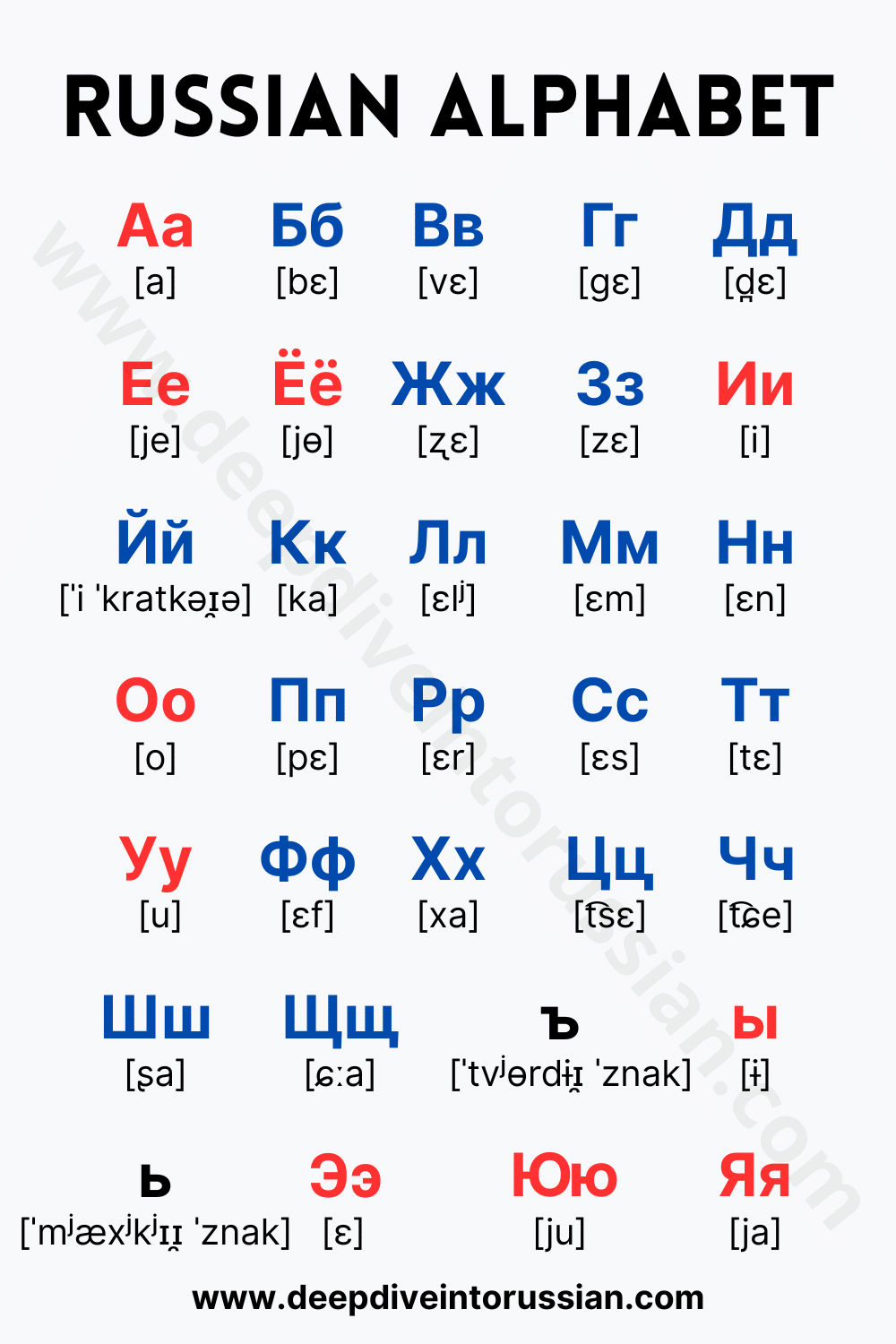
Capitals and Lowercase, Print and Handwriting
As in English, Russian letters have uppercase and lowercase forms.
Russian also distinguishes printed and handwritten (cursive) forms, which look quite different. It’s essential for learners to recognise and practise both styles. (See the table below.)

The Two Signs (‘ъ’ and ‘ь’)
The signs ‘ъ’ (hard sign) and ‘ь’ (soft sign) do not represent sounds but influence pronunciation.
- ‘ъ’ separates a consonant from a following iotated vowel — one that begins with a [j] sound, such as ‘е’, ‘ё’, ‘ю’, or ‘я’.
Examples: подъе́зд [pɐˈdjest] (entrance, porch), съёмка [ˈsjɵmkə] (filming), конъюнкту́ра [kənʲɪ̯ʊnˈkturə] (conjuncture), объявле́ние [ɐbɪ̯ɪˈvlʲenʲɪɪ̯ə] (announcement, ad). - ‘ь’ shows that the preceding consonant is palatalised(soft).
Compare:- мат [mat] (checkmate (in chess); profanity)
- мать [matʲ] (mother)
Why the Alphabet Matters
Knowing the Russian alphabet lays the foundation for reading and writing. It’s the first big step toward mastering the language.
Check out my post on Russian animal sounds for beginners — a playful way to practice Russian!
Activity
Match the printed and cursive letters of the Russian alphabet by dragging one card onto another. If you make a mistake, click the tape connecting the cards to detach them. Click the tick in the bottom right corner to check your answers.
- If you are using a mobile device, tap the expand icon in the top right corner and the exercise will open in a new window.