Types of Russian Numerals by Meaning
In Russian, numerals are divided by meaning into two main types — quantitative and ordinal.
Коли́чественные числи́тельные (Quantitative Numerals)
Quantitative numerals show how many objects or units there are and answer the question ско́лько? (how many?).
They fall into three groups:
- це́лые (whole) — denote complete units:
пять (five), се́мьдесят (seventy), девятьсо́т (nine hundred) - дро́бные (fractional) — denote parts of a whole or fractions:
одна́ со́тая (one hundredth), две тре́тьих (two thirds), полтора́ (one and a half) - собира́тельные (collective) — refer to a group of items viewed as one whole:
о́ба (both), че́тверо (all four/a group of four), де́сятеро (all ten/a group of ten)
Поря́дковые числи́тельные (Ordinal Numerals)
Ordinal numerals show the position or order of something in a sequence and answer the question кото́рый? (which one?).
Examples: пе́рвый (first), девяно́стый (ninetieth), пятисо́тый (five hundredth).
Types of Russian Numerals by Structure
Besides their meaning, numerals can also be grouped by structure:
- просты́е (simple) — consist of a single root:
три (three), пя́теро (all five), семна́дцатый (seventeenth) - сло́жные (complex) — consist of two or more roots:
шестьдеся́т (sixty), четы́реста (four hundred), двухты́сячный (two thousandth) - составны́е (compound) — formed by combining several numerals, written with spaces:
два́дцать оди́н (twenty-one), де́вять деся́тых (nine tenths), сто оди́ннадцатый (one hundred and eleventh)
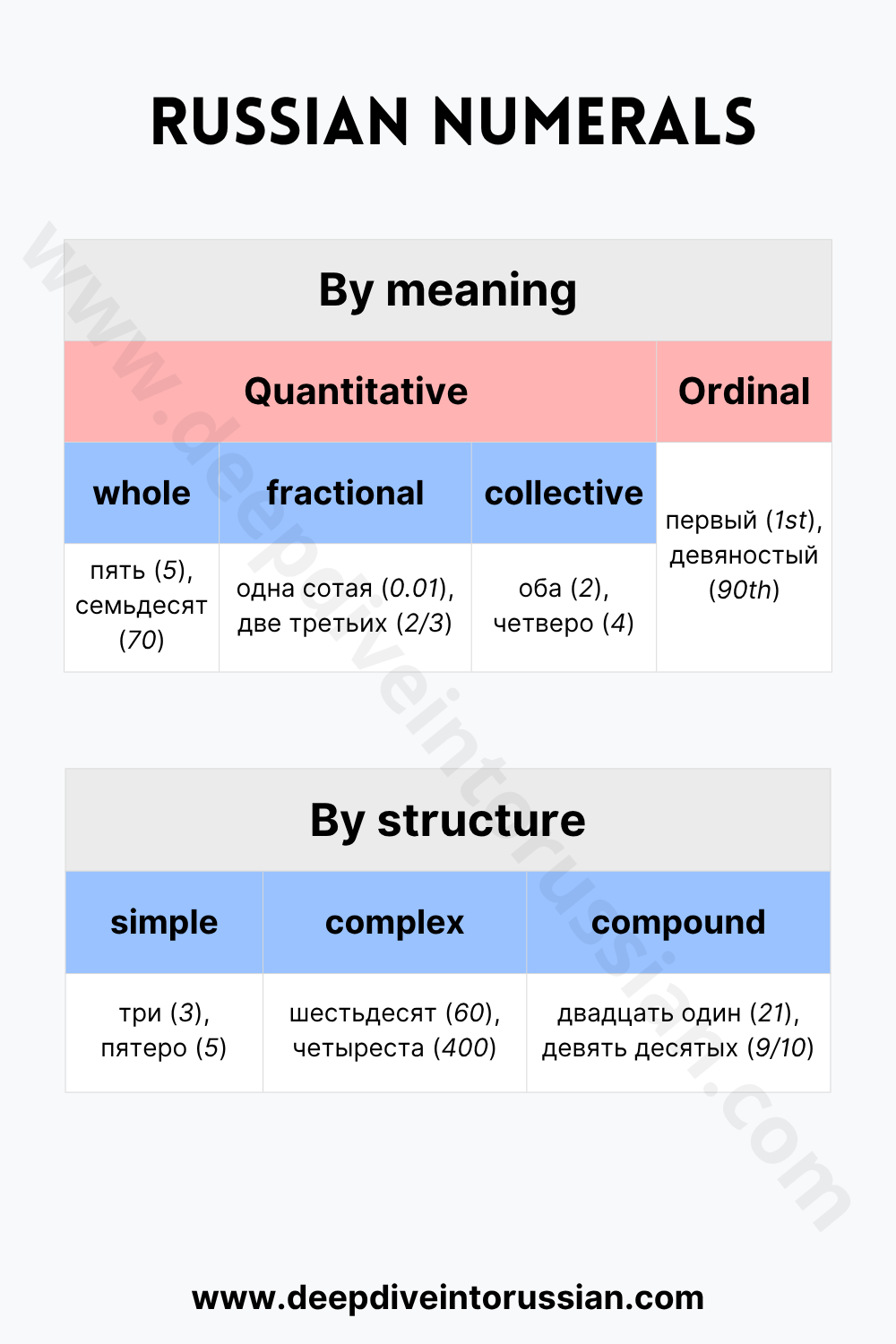
Guide to Russian numerals
In Brief
- Quantitative numerals show numbers, amounts, or collections of objects.
- Ordinal numerals express the order of objects in a series.
- By structure, numerals can be simple, complex, or compound.
- Understanding these types helps you use numerals accurately in speech and writing.
When in doubt, check the numeral’s type or form in a dictionary.