Definition of Pronouns
Pronouns refer to people, objects, qualities, or quantities without naming them directly.
They substitute nouns, adjectives, or numerals in a sentence.
Main Types of Russian Pronouns
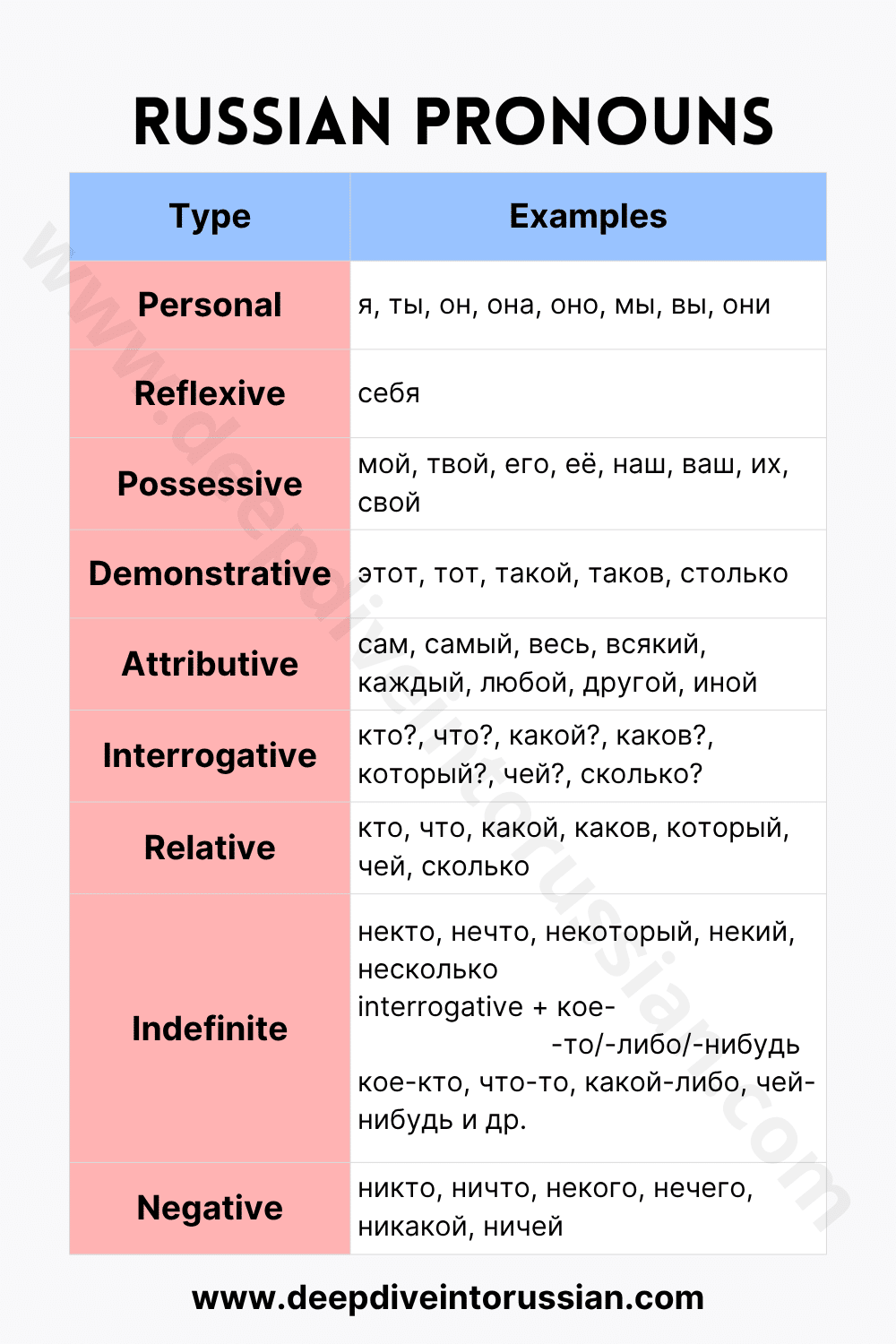
Russian pronouns are traditionally divided into nine types according to their meaning.
Ли́чные (Personal)
Refer to participants in a conversation, others not involved, and objects: я (I), ты (you), он (he), она́ (she), оно́ (it), мы (we), вы (you), они́ (they).
Example: Мы идём гуля́ть. (We are going for a walk.)
💡 Note: Russian distinguishes the forms of 'you': ты (informal singular), Вы (formal singular), вы (plural). Verb forms and politeness change accordingly.
Examples:
Я ра́да, что ты пришёл. (I’m glad you came.) — informal, to a friend
Я ра́да, что Вы пришли́. (I’m glad you came.) — formal, to a stranger or superior
Я ра́да, что вы пришли́. (I’m glad you came.) — plural, addressing a group
Возвра́тное (Reflexive)
Shows that the action is directed back to the subject: себя́ (oneself).
Example: Она́ мо́жет постоя́ть за себя́. (She can stand up for herself.)
Притяжа́тельные (Possessive)
Express possession or belonging: мой (my), твой (your), его́ (his), её (her), наш (our), ваш (your), их (their), свой (one’s own).
Example: Мой телефо́н разряди́лся. (My phone ran out of battery.)
💡 Note: 'Ваш' is the possessive form of 'Вы'.
Указа́тельные (Demonstrative)
Point to a specific object, feature, or quantity: э́тот (this), тот (that), тако́й (such), тако́в (such), сто́лько (so much/so many).
Example: Э́тот стул удо́бный. (This chair is comfortable.)
💡 Note: ‘Тако́в’ is a synonym of ‘тако́й’ but is less common in modern speech.
There’s a short note about an old-fashioned pronoun that still appears in set expressions in this post.
Определи́тельные (Attributive)
Indicate a general characteristic or quality of an object: сам (self), са́мый (the most/the very), весь (all/whole), вся́кий (every/any), ка́ждый (every/each), любо́й (any), друго́й (other/another), ино́й (other/another).
Example: Сын сам пригото́вил обе́д. (My son made lunch by himself.)
Вопроси́тельные (Interrogative)
Used to form questions: кто? (who?), что? (what?),како́й? (what?/which?), како́в? (what?/which?), кото́рый? (which?), чей? (whose?), ско́лько? (how many?/how much?).
Example: Каки́е пла́ны на выходны́е? (What are your plans for the weekend?)
💡 Note: ‘Како́в’ is a synonym of ‘како́й’ but is less common in modern speech.
Относи́тельные (Relative)
These are the same as interrogative pronouns, but they function as connecting words in complex sentences: кто (who), что (what), како́й (what?/which?), како́в (what?/which?), кото́рый (which), чей (whose), ско́лько (how many/how much).
Example: Не подска́жете, кото́рый час? (Do you know what time it is?)
Неопределённые (Indefinite)
Refer to an unknown or unspecified person, object, quality, or quantity: не́кто (someone/somebody), не́что (something), не́который (some/certain), не́кий (certain), не́сколько (a few/several).
Some indefinite pronouns are derived from interrogative ones by adding the prefix ко́е- or the suffixes -то, -ли́бо, -нибу́дь: кое-кто́ (someone/somebody), что́-то (something), ка́кой-либо (any), че́й-нибудь (someone’s), etc.
Example: Кто́-то позвони́л в дверь. (Someone rang the doorbell.)
Отрица́тельные (Negative)
Express the absence of a person, object, or quality: никто́ (no one/nobody), ничто́ (nothing), не́кого (no one/nobody), не́чего (nothing), никако́й (no), ниче́й (nobody’s/no one’s).
Example: Ничего́ не случи́лось. (Nothing happened.)
💡 Note: The translations provided in the text are only some possible options. Depending on context or sentence structure, a Russian pronoun may be translated differently.
In Brief
- Pronouns help you avoid repeating the same words over and over.
- There are nine types of pronouns, each with its own function.
- Knowing these types makes it easier to use pronouns correctly and naturally in speech.
If you’re not sure how a pronoun works, just look it up in a dictionary.